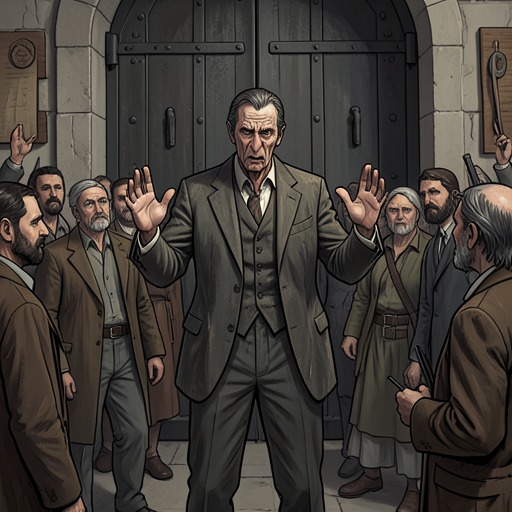
Eberhard Fritsch
The Disappearance of Josef MengeleEberhard Fritsch, director of Dürer Publishing and publisher of Der Weg, helped make Buenos Aires a gathering point for former Nazis and their sympathizers. He offered them more than a newspaper: his publishing venture gave their ideas public space, connected stranded men to practical support, and helped sustain a network built around denial of Nazi crimes. His later role in recording Eichmann’s testimony exposed the tension at the heart of that project: Fritsch sought to defend Nazism, but the interviews made the scale of its crimes impossible to dismiss as mere accusation.
Publisher and political convictions
Fritsch ran Dürer Publishing from 542 Sarmiento Avenue in Buenos Aires. When Gregor came to see him, Fritsch listened as the visitor described his military service while concealing his identity. Fritsch sympathized with the older man’s sense of exile and longing for Germany, and presented the publishing house as a place where men in that position could find assistance. His assurance that Argentina offered distance from their past was part of a broader promise of safety and belonging.
That promise rested on a deliberate political commitment. Fritsch had founded the publishing house to help former soldiers and gave Der Weg’s columns to blood-and-soil writers whose work was censored in Europe. He also arranged practical aid during shortages, including stock cubes, tinned meat, and cocoa powder. The newspaper and its associated networks thus joined ideological advocacy to material support: it circulated Nazi writing while helping exiles meet immediate needs.
Fritsch’s own outlook was shaped less by direct experience of Germany than by his childhood participation in a Hitler Youth rally. He had visited Germany only once, in 1935, at the age of fourteen, but remembered the rally with vivid enthusiasm. He rejected reports of Nazi atrocities as hostile propaganda and repeated antisemitic explanations for them. When he described Argentina as a place where no one would ask about a newcomer’s origins, his confidence depended on a political culture that he believed would be indifferent, or sympathetic, to the fugitives’ pasts.
A hub for former Nazis
Der Weg drew a wider circle of former Nazi figures into Fritsch’s orbit. Gregor encountered Josef Schwammberger, a former commandant of forced-labour camps in Poland, and Reinhard Kopps, a specialist in conspiracy writing who had formerly worked with Heinrich Himmler’s intelligence agencies in the Balkans. Fritsch regarded Willem Sassen as the newspaper’s outstanding writer and a major contributor to its growing success. The journal was not simply a publication office: it served as a meeting place among men with histories of wartime service, collaboration, and postwar escape.
Fritsch cultivated this community through editorial access and personal contacts, while the newspaper’s language offered its members a shared account of their past. Gregor, who valued proximity to influential men, returned to the journal repeatedly. The resulting network joined public propaganda to private association; its members could encounter one another, exchange support, and speak as if the Nazi cause remained intellectually and politically intact.
The Eichmann recordings
In April 1957, Fritsch joined Sassen’s recording sessions with Eichmann, held on Sundays at Sassen’s home. The gatherings attracted a circle of men and women around the former Nazi official, who spoke at length about his role and the wartime extermination program. Fritsch was among those who had resisted accepting accounts of Nazi crimes as true. Yet over six months, Eichmann described mass killings, gas chambers and ovens, forced labour, death marches, and famine, confirming the scale of the crimes to Fritsch, Sassen, and the other listeners.
The testimony unsettled the assumptions that had held the group together. Fritsch and Sassen had hoped to preserve an image of Nazism as essentially pure, and to explain its crimes as the result of betrayal or manipulation. Eichmann’s account instead supplied confirmation from within their own circle. Sassen retained the recordings, but Dürer Publishing cancelled the planned book. The sessions therefore produced a stark reversal: an effort to give a former Nazi a platform to rehabilitate his reputation yielded evidence that undermined the listeners’ preferred defense.
Closure and aftermath
Der Weg faltered, and Fritsch closed Dürer Publishing before leaving for Austria in early 1958. After being banned from publishing, he worked as a night porter at a large hotel in Salzburg. The change marked a sharp contraction of the public role he had built in Buenos Aires: the publisher who had offered Nazi writers a voice and exiles a meeting point could no longer continue that work under his own imprint.
Fritsch’s trajectory links two forms of postwar activity: the organized effort to shelter and sustain former Nazis, and the attempt to reshape public memory through publishing. His newspaper and business had made that project tangible through articles, contacts, and supplies. But the Eichmann recordings revealed the limits of ideological denial when confronted with a perpetrator’s own account. The book was abandoned, the publishing house closed, and Fritsch’s career ended not in a return to influence but in a low-profile job in Austria.